
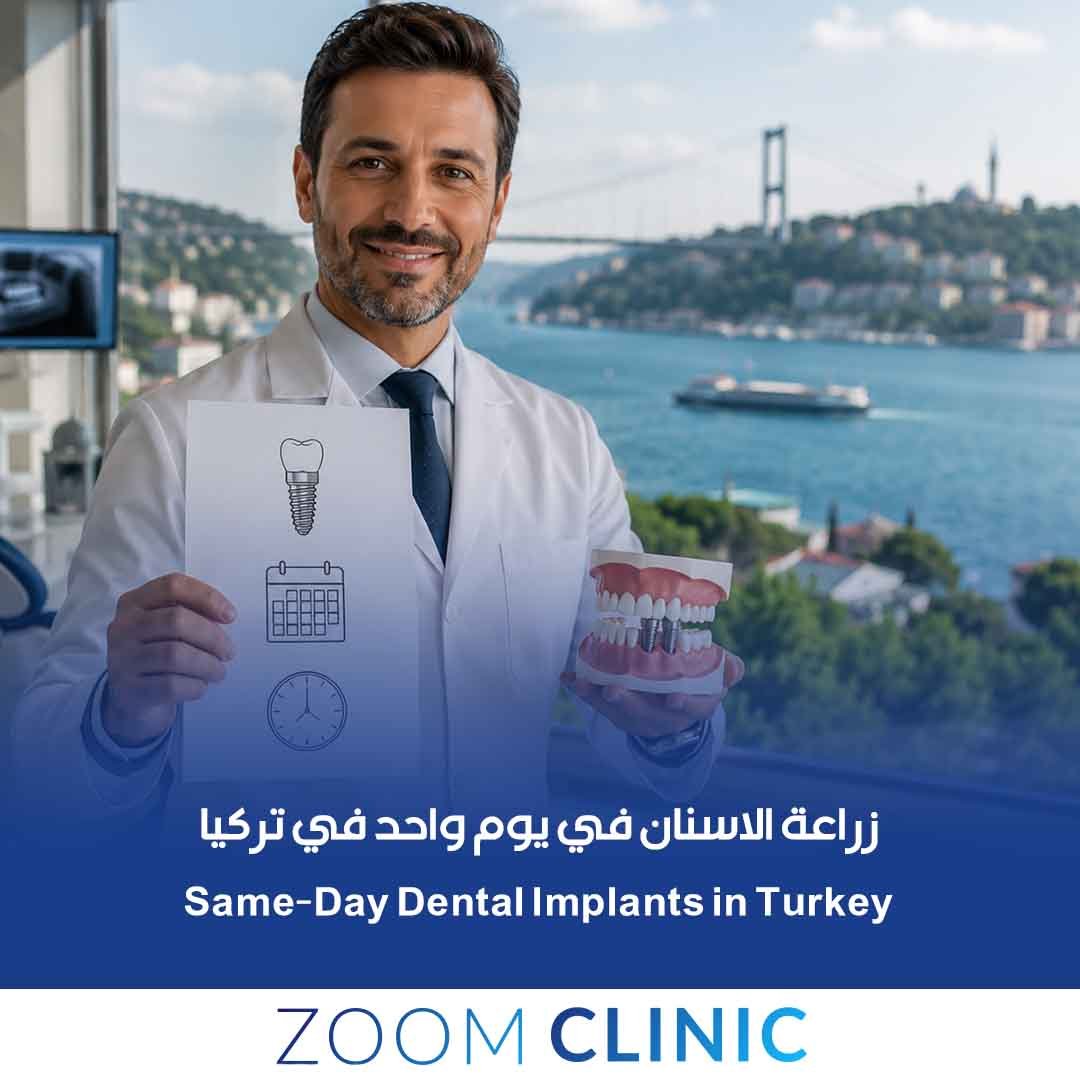
Many people live for years with a gap in their teeth. Not because they don’t want treatment, but because the idea of surgery, the length of time, and the steep cost make them postpone the decision again and again.
Then they hear the phrase “same-day dental implants in Turkey” and pause: Is this real? Is it safe? Does it fit my case?
This guide answers these questions with accurate medical information, and with complete honesty, because your decision deserves more than marketing promises.
Content
What Exactly Are Same-Day Dental Implants?
Immediate Loading, The Precise Definition
When you hear “dental implants in one day,” what you’re hearing about is a medical technique called Immediate Loading.
The practical meaning: the implant is placed inside the jawbone, then a functional temporary crown is fixed onto it, all within the same session or within 24 to 48 hours at most. You enter the clinic with a missing tooth, and you leave with a new tooth you can speak and chew with on the same day, for eligible cases.
The Difference Between Immediate Implant Placement and Immediate Loading
Many people confuse these two terms, and this confusion causes mistaken expectations:
- Immediate implant placement: the implant is placed right after tooth extraction, but you leave without a crown, and wait months until one is fitted.
- Immediate loading (the subject of this guide): you leave with a functional crown on the same day, whether the implant is in a freshly extracted site or an older gap.
The core difference: do you leave with a tooth you can actually use or not? With immediate loading, yes.
What Do You Actually Get on Day One?
Just two things:
- A biocompatible titanium implant, precisely fixed inside the jawbone.
- A functional temporary crown that restores normal chewing and speech, doing its job for about 3 months before being replaced with the permanent crown.
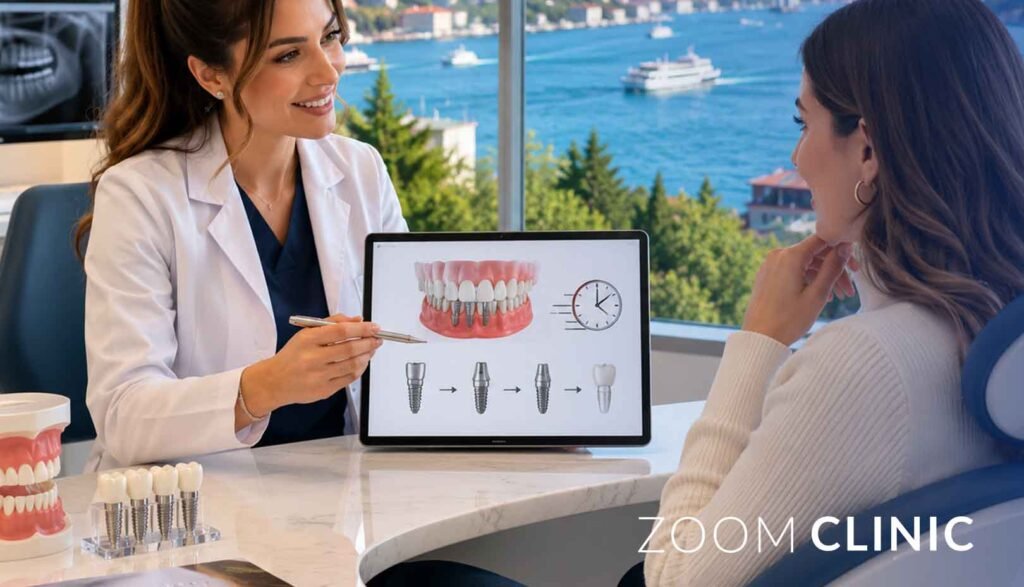
Why Is One Day Enough? The Medical Basis
Primary Stability: The Foundation Everything Rests On
The question every patient honestly asks: why does a dentist in Turkey finish everything in one day, while another dentist asks you to wait months?
The answer: the difference isn’t only in the dentist’s skill, but in meeting a specific medical condition called Primary Stability. When the implant adheres to the jawbone with enough force and shows no movement at all, the bone can bear the weight of the crown immediately. Waiting months in the traditional protocol compensates for weaker stability by giving the bone time to fuse gradually.
ISQ Measurement, How Does the Dentist Know It’s Ready?
A competent dentist doesn’t guess, they measure. An Osstell device is used to measure the ISQ value (Implant Stability Quotient), a number that expresses how firmly the implant is anchored in the bone.
The scientific literature in this field isn’t a single fixed number, but a threshold that varies by study and device: clinical studies published in PMC used a threshold of ISQ ≥65 with an insertion torque exceeding 30 Newton-centimeters as the criterion for safe immediate loading in fresh extraction sites, while the manufacturer of the Osstell device recommends that any value below 65 calls for an additional healing period before re-measuring. This slight variation between studies means the final decision rests with the dentist, based on the actual measurement rather than a fixed theoretical number.
If the dentist measures these values in the operating room and finds them suitable, the crown is fitted the same day. If the required threshold isn’t reached, the dentist immediately decides to switch to a different protocol, and that’s a decision of wisdom, not failure.
3D Digital Planning (CBCT)
One reason medical tourism clinics in Turkey have advanced is the widespread adoption of CBCT (Cone Beam Computed Tomography), which gives the dentist a precise 3D map of the jawbone, density, height, width, and the ideal angle, before surgery even begins. The result: higher precision, shorter time, and more predictable outcomes.
Who Is a Good Fit for This Technique?
The Ideal Candidate
- Sufficient bone density at the implant site.
- Healthy gums free of active inflammation.
- Stable general health, no uncontrolled diabetes, no clotting disorders, no medications affecting bone such as bisphosphonates.
- Non-smoker or light smoker; heavy smoking reduces blood flow to the gums and slows bone integration.
Who Needs a Different Treatment Plan
- Those with weak bone density or who need prior bone grafting.
- Those with active inflammation at the implant site.
- Those with uncontrolled chronic conditions affecting wound healing.
- Heavy smokers, where early failure rates rise noticeably.
The Role of Bone Grafting in Dental Implants
What If You’ve Lost Multiple Teeth or Your Entire Jaw?
Immediate loading for a single tooth or a few teeth differs from cases of losing an entire jaw or most of it. In these latter cases, different techniques are used such as All-on-4 or All-on-6, which rely on 4 or 6 implants to support a complete fixed bridge, often in one day as well.

What If Primary Stability Isn’t Achieved on Surgery Day?
This is a question few people ask, and everyone should ask it.
If the ISQ measurement reveals that the implant hasn’t reached the required stability threshold, the dentist immediately stops the immediate loading process and leaves the implant inside the bone to integrate naturally, then fits the crown after integration is complete, following the traditional timeline.
You won’t lose the implant. And you won’t lose hope. You’ll only lose “one day”, and gain a safe, reliable result in the long run. A dentist who changes their decision in the operating room based on measurements is a dentist who deserves your trust.
The Patient Experience: What Happens on Surgery Day?
Before Traveling
Send the clinic, before booking: recent X-rays of your jawbone (panoramic or CBCT), a list of current medications, and a summary of your medical history. This pre-assessment determines your eligibility for immediate loading before you travel.
Morning: Arrival and Planning
The day begins with a 3D CBCT scan if an up-to-date image isn’t available. The dentist then explains what the scan shows, maps out the surgical plan in front of you, and answers your questions before any procedure begins.
The Operating Room: From Anesthesia to the Crown
After full local anesthesia, surgery begins. In many cases, flapless technique is used (no incisions, no stitches), which reduces bleeding and speeds recovery. The dentist places the implant, then immediately measures the ISQ value. If the results are suitable, a digital impression is taken, the temporary crown is fabricated within hours in the in-house lab, and fitted before the end of the day. The entire session usually takes between two and four hours.
Afternoon: First Weeks’ Ground Rules
- First 24 hours: soft foods only (yogurt, warm soup, boiled eggs).
- First two weeks: avoid direct chewing on the implant site, and avoid hard or crunchy foods.
- Throughout the integration period: avoid smoking entirely.
Mild swelling and a feeling of pressure in the first hours is completely normal and fades on its own.
What Happens After Day One? The Path to the Permanent Crown
After 3 Months: The Second Visit
After osseointegration is complete, the biological process by which the jawbone fuses with the titanium implant surface, you return for a second visit lasting no more than two days. The dentist examines the implant, the temporary crown is removed, a precise impression is taken, and the permanent crown, made of zirconia or high-quality porcelain, is fitted, matching the shape and color of your natural teeth.
How Long Does the Implant Last?
According to data from the American Dental Association (ADA), dental implants achieve a high survival rate over ten years with regular oral care. Daily cleaning, a dental check-up every 6 months, and avoiding harmful habits, this is the recipe for an implant that lasts you for many years.
The Success Rate of Dental Implants: What You Need to Know
What Do Scientific Studies Say About Immediate Loading?
A retrospective study published in PMC, conducted by researcher Bavetta and colleagues, compared immediate loading of implants in fresh extraction sites against the traditional protocol on healed bone. In the control group, an insertion torque exceeding 20 Newton-centimeters and an ISQ value exceeding 60 were adopted as the criterion for immediately fitting the temporary crown, while an ISQ value of 65 or higher was adopted for fitting the final restoration. This confirms that the clinical thresholds actually used in medical practice are close to the values followed by specialized clinics in Turkey.
The clinical guidelines issued by the manufacturer of the Osstell device, the most widely used reference globally for measuring ISQ, also indicate that an ISQ value below 65 at the time of loading calls for an additional healing period, with re-measurement after three weeks until the required level is reached. This means the “safe threshold” isn’t a marketing figure, but a documented, internationally followed scientific protocol that precisely determines when immediate loading is appropriate and when waiting is necessary.
Factors That Determine the Success of Your Specific Case
- Bone quality and density at the implant site.
- The ISQ value achieved during surgery, the most important decision point.
- Implant quality and surface roughness, a rougher surface creates a larger bonding area with the bone.
- Your adherence to instructions during the integration period.
- The surgeon’s experience and the precision of digital planning.
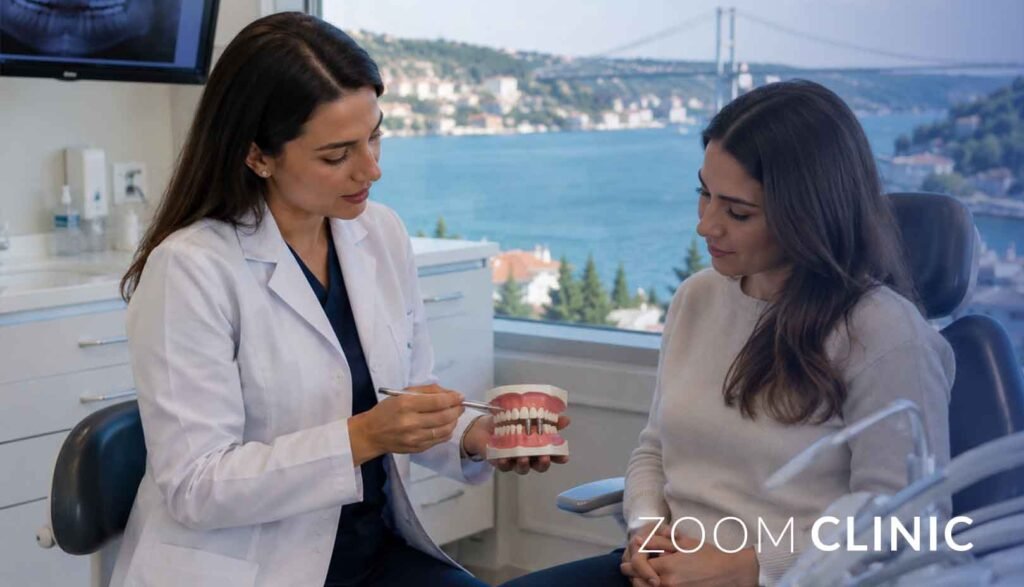
The Cost of Same-Day Dental Implants in Turkey
A Realistic Price Comparison (For a Single Implant Including Crown)
| Country | Average Cost of a Single Implant Including Crown |
| Germany / United Kingdom | €2,500 – €4,000 |
| Gulf Arab States | $1,500 – $3,000 |
| Turkey | $500 – $1,200 |
These figures apply to a single implant or a limited number of teeth. If your case requires replacing the entire jaw, the cost and technique differ substantially.
The gap between Turkey and Western countries reaches 70% in some cases; meaning the cost of a flight ticket and a full week’s stay in Istanbul is still less than the price of a single implant in Europe.
What Does the Comprehensive Package Usually Include?
- Pre-treatment diagnostic imaging (CBCT or panoramic).
- The full cost of the implant and temporary crown.
- Follow-up during your stay in Turkey.
- Translation services and coordination with the hotel and transport in some packages.
Tip: Always ask for a detailed breakdown of what the package includes and excludes before confirming your booking, especially regarding the cost of the permanent crown on the second visit.
Frequently Asked Questions
Can I really get a fully functional tooth in one day in Turkey?
Yes, in eligible cases through the immediate loading technique, where the implant is placed and the temporary crown is fitted in the same session. You return after about 3 months to fit the final permanent crown.
What’s the most important medical condition that determines whether you’re suited for this technique?
Achieving “primary stability” of the implant within the jawbone, measured by the dentist with an Osstell device directly during surgery via the ISQ value. Anyone who doesn’t meet the required threshold needs a more conventional, safer protocol for their specific case.
Will you feel pain during the procedure or afterward?
The procedure is performed under full local anesthesia, and the patient feels no pain during the session. After the anesthesia wears off, mild discomfort or swelling may appear, lasting no more than the second or third day, managed with routine pain relievers.
How many days does my trip to Turkey take for this procedure?
The first visit includes the assessment day, the surgery day, then a day or two for follow-up, between 3 and 5 days total. You return after about 3 months for a second visit lasting only two days to fit the permanent crown.
Is the crown you get on the first day permanent or temporary?
It’s a functional temporary crown that restores shape, chewing, and speech during the period the implant integrates with the bone. The final crown, made of zirconia or porcelain, is fitted on the second visit after osseointegration is complete.
Conclusion
Same-day dental implants in Turkey aren’t a slogan, but a scientifically documented medical protocol, applied daily in specialized medical tourism clinics. But its success starts with an informed decision: knowing whether your case qualifies for this technique, and trusting a medical team that puts your interest above all else.
At Zoom Clinic, every case begins with a real assessment and ends with an honest medical decision. Contact us today for an initial assessment, and we’ll tell you honestly whether same-day dental implants are the right choice for your case.
Note: This article is for informational purposes only and does not constitute individual medical advice. Always consult a qualified dentist to assess your specific case before making any treatment decision.
Get the special offer today from Zoom Clinic
Scientific References
- Bavetta G. et al., “A Retrospective Study on Insertion Torque and Implant Stability Quotient (ISQ) as Stability Parameters for Immediate Loading of Implants in Fresh Extraction Sockets”, BioMed Research International, PMC. pmc.ncbi.nlm.nih.gov/articles/PMC6875416
- Osstell AB, “The Osstell ISQ Scale, Evidence-based clinical guidelines.” osstell.com/clinical-guidelines/the-osstell-isq-scale
- American Dental Association (ADA), guidelines on dental implants and post-surgical care: ada.org