

You’ve made your decision to get All-on-4 dental implants, or perhaps you’ve just completed the procedure and want to know exactly what lies ahead in the coming days and months. Either way, understanding the All-on-4 recovery timeline in precise detail is the first and most important step toward a successful, long-lasting outcome.
What many patients don’t realize is that recovery after All-on-4 doesn’t happen in one phase but two entirely different ones: the first is surface-level soft tissue and gum healing within the first two weeks, and the second is deep osseointegration that continues for three to six months. Knowing the difference between these two phases will change everything about how you approach your recovery.
If you’re considering the procedure in Turkey or need a broader overview of general dental implant recovery timelines as a first step, you can read our comprehensive guide on dental implant recovery time for international patients at Zoom Clinic.
content
Why the All-on-4 Recovery Timeline Differs from Traditional Implants
Immediate Teeth, but Deep Healing Follows Its Own Pace
One of the most celebrated advantages of the All-on-4 technique is that you leave the clinic on the very same day as surgery with a fixed temporary prosthesis already in place and immediately usable. This remarkable feature does not mean recovery is complete, it means your body has just begun its true journey toward deep and lasting healing.
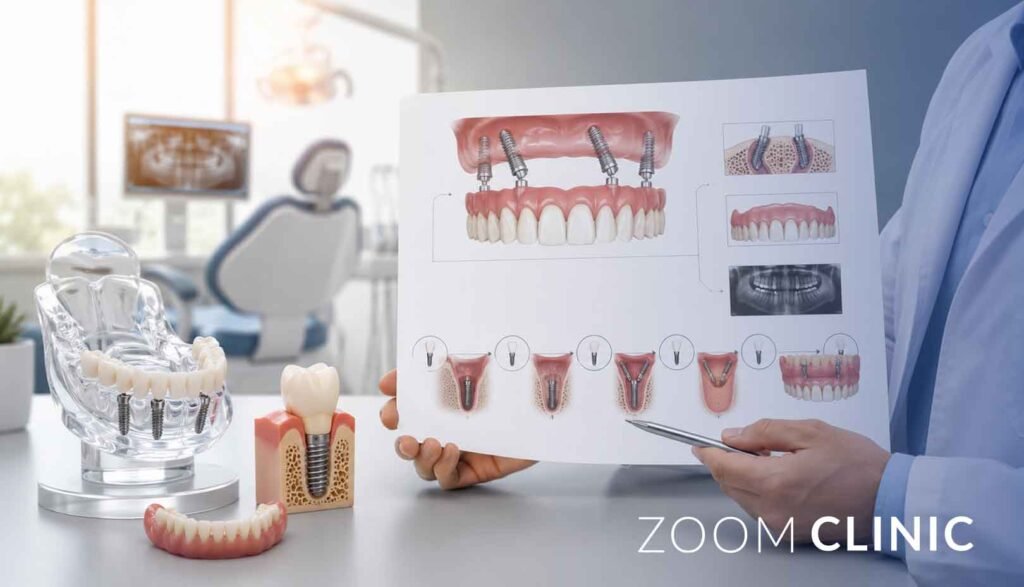
Unlike traditional implant procedures that typically require prior bone grafting and waiting periods between stages that can stretch over many months, All-on-4 dramatically condenses the surgical process thanks to the angled placement of the rear implants at 30 to 45 degrees. However, regardless of the technique used, osseointegration, the biological fusion of titanium with living jawbone, always proceeds at its own biological pace that neither the doctor nor the patient can rush.
The Two Healing Phases You Must Understand Before Surgery
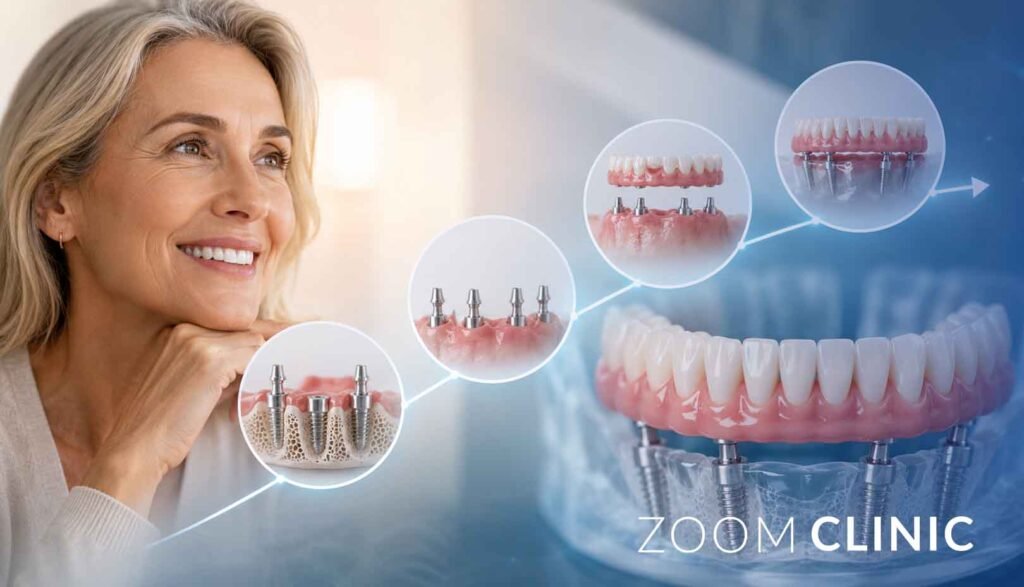
Phase One, Soft Tissue Healing: Begins on day one and lasts approximately two weeks, during which the gums heal, visible symptoms such as swelling, pain, and bruising gradually subside, and the patient notices clear, tangible improvement day by day.
Phase Two, Osseointegration: Begins silently in the background from day one and continues for three to six months. This is the phase during which titanium fuses with the living bone cells of your jaw to form a solid, unified, and completely stable foundation that will permanently support your final teeth.
All-on-4 Recovery Timeline
Day-by-Day All-on-4 Recovery: From the Moment of Surgery Through the First Week
Day of Surgery, What Happens and How to Respond Wisely
As soon as surgery is complete and you leave the operating area, you will absolutely need a trusted companion to take you to your accommodation, as the effects of local or mild intravenous sedation typically take four to five full hours to wear off completely.
Keep your head elevated on two or three pillows when resting to reduce fluid accumulation in the surrounding tissues, and apply ice packs wrapped in a soft cloth to your face for twenty minutes on, then twenty minutes off, repeating this cycle throughout the day. Take all prescribed medications on their exact scheduled times, do not wait for pain to escalate before taking them.
Do not touch the surgical sites with your tongue or fingers no matter how strong the temptation, and completely refrain from any vigorous rinsing on this first day in particular, as this protects the delicate initial blood clot that forms the very foundation of proper healing.
Hours One Through 72, Peak Swelling and Discomfort
According to the protocols of the European Association for Osseointegration (EAO), swelling typically peaks between 8 and 48 hours after surgery, and this swelling may extend to your cheeks, the sides of your neck, and be accompanied by light bluish or yellowish bruising around the jaw and under the eyes, all of this is entirely normal and expected and requires no alarm.
Continue alternating ice pack applications during the first 24 hours, then gradually transition to warm compresses to stimulate circulation and accelerate the natural reabsorption of swelling. Drink plenty of cool and moderately warm liquids, and avoid hot beverages entirely during this period.
What to Eat During the First 72 Hours After All-on-4 Surgery:
- Fresh cold fruit juices (avoid acidic citrus)
- Yogurt, milk, soft puddings, and dairy products
- Cooled or very mildly warm soups and broths (never hot)
- Ice cream and cold smoothies (the cold actively helps reduce swelling)
- Mashed banana or pureed vegetables
Days Four Through Seven, The Phase of Noticeable Improvement
By day four in most cases, patients notice a significant and clear reduction in swelling and pain levels, and begin to feel a near-normal return of their ability to speak and smile without the same degree of discomfort.
You can begin gently rinsing your mouth with warm salt water (one small teaspoon of salt dissolved in one cup of water) after each meal, with a very gentle swishing motion and absolutely no vigorous rinsing. Begin gradually introducing mashed soft-boiled eggs, banana, avocado, and mashed potato into your diet, always being careful to avoid placing any direct biting force on the front teeth.
Always remember that the temporary teeth fitted at this stage are a transitional bridge designed for light function and aesthetics, they are not engineered to bear the full chewing forces you will enjoy once your permanent teeth are placed.
Weeks Two and Three, A Gradual Return to Normal Daily Life
When Can You Return to Work Safely?
Most patients return to desk-based, intellectual, or administrative work somewhere between day three and day seven depending on personal comfort levels. Jobs requiring notable physical exertion, heavy lifting, or exposure to vibrations should be postponed for a full two weeks without exception.
The American Academy of Implant Dentistry (AAID) warns that early physical exertion during the first week raises blood pressure in the areas immediately surrounding the implant sites, which can trigger sudden renewed bleeding and fundamentally compromise the healing process. Patience at this stage is not a luxury, it is a medical necessity.
Foods You Can Gradually Reintroduce During Week Two
Starting from the second week you can progressively and cautiously add:
- Well-cooked pasta and rice cooked to softness
- Gently prepared non-fried fish
- Soft-boiled vegetables such as carrots and zucchini
- Soft cheeses and various dairy products
- Well-cooked chicken cut into very small pieces
Continue to strictly avoid without exception: anything crunchy, hard, or that requires forceful biting with the front teeth, anything sticky that clings between the teeth, and anything requiring prolonged continuous chewing.
Daily Care for Your Temporary Teeth at This Stage
Use a very soft-bristled toothbrush with a low-abrasion toothpaste twice daily with a slow, gentle, guided motion. Use implant-specific floss or a water flosser to achieve precise cleaning beneath the prosthesis and between the teeth.
Completely avoid all alcohol-based mouthwashes during the first months, and opt instead for antiseptic rinses such as diluted chlorhexidine solution as prescribed by your dental team. This meticulous daily care is not optional, it is the primary prevention against the complications of peri-implant inflammation.
All-on-4 Recovery Timeline
Month One Through Three, The Critical Osseointegration Phase
What Is Osseointegration and Why Is It the Primary Determinant of Long-Term Success?
Osseointegration is the precise biological process through which titanium, the material your implants are made of, fuses directly with the living bone cells in your jaw to form a single, homogeneous, and completely stable unit. This fusion is what transforms an implant from merely a foreign body in the jaw into a true artificial root that functions identically to a natural tooth root.
Research published in the journal Clinical Oral Implants Research through multiple longitudinal studies confirms that the success of the osseointegration phase is the primary and most important determinant of long-term implant survival, and that the All-on-4 success rate exceeds 95% over ten years when correct protocols are followed. During these three months, your body works with intensive effort deep beneath the surface, even if you feel no pain or noticeable discomfort whatsoever.
What to Expect and What to Strictly Avoid During This Critical Phase
What you will feel: Near-complete resolution of any pain or discomfort after the second week, a gradually increasing and growing sense of stability in the temporary teeth, and an increasingly comfortable ability to eat with greater ease and confidence.
What must be strictly avoided throughout these months:
- Smoking, the European Association for Osseointegration (EAO) warns that smoking significantly multiplies the risk of osseointegration failure by reducing blood flow and depriving tissues of oxygen
- Alcohol, impairs the natural immune response, slows cellular regeneration, and interacts negatively with medications
- Hard and solid foods, any excessive pressure can disrupt the delicate ongoing integration process before its completion
- Missing follow-up appointments, the most common mistake made by patients and the most costly in the long run
Recommended Follow-Up Appointment Schedule During Recovery
| Timing | Medical Purpose of the Visit |
| One to two weeks post-surgery | Gum healing check, suture removal, temporary teeth assessment |
| Month one | Initial integration assessment and prosthesis adjustment and calibration |
| Month three | 3D X-ray imaging to measure the percentage of osseointegration progress |
| Months four to six | Planning, design, and placement of permanent final teeth |
Months Three to Six, Your Permanent Teeth Are Almost Ready
When Is the Final Permanent Prosthesis Placed?
Once complete osseointegration is fully confirmed through 3D diagnostic imaging and clinical stability testing of the implants, the medical team begins designing your permanent prosthesis with high digital precision using CAD/CAM technology. The final prosthesis is crafted from premium-grade materials such as reinforced zirconia or advanced medical-grade PMMA, then permanently and securely fixed onto the four implants as the definitive replacement for the temporary set.
This moment marks the true and complete beginning of enjoying your new teeth fully, with a fundamental improvement in chewing strength, aesthetic appearance, and the quality of every detail in your daily life.
The Factors That Distinguish Fast from Slow Recovery
Not all patients heal at the same pace along the recovery journey, and this is entirely normal and completely expected. The main factors that can prolong or complicate the recovery timeline include:
- Age: The regenerative capacity of bones and soft tissues naturally declines with advancing age
- Poorly controlled diabetes: Directly weakens the immune response and slows wound healing and osseointegration
- Smoking: Reduces oxygen flow to tissues and raises implant failure rates in a scientifically proven manner
- Low bone density: May require additional time for complete fusion compared to dense, healthy bone
- Adherence to post-operative instructions: The single most impactful factor of all, and the one most completely within the patient’s own control
Warning Signs You Should Never Ignore During the Recovery Period
All-on-4 Recovery Timeline
Normal post-surgical symptoms always move in one direction: toward gradual and continuous improvement. Any symptom that escalates rather than diminishing, or returns after it had improved, requires immediate contact with your medical team without hesitation or delay:
- Pain that increases after day seven rather than continuing its gradual decline
- Continuous bleeding beyond 48 hours from surgery without stopping or notable reduction
- Swelling that doubles or worsens on day four or five instead of gradually subsiding
- Persistent and intensifying foul odor or taste in the mouth as a possible indicator of infection at an implant site
- Noticeable and continuous movement or looseness in the temporary prosthesis greater than at initial fitting
- Body temperature elevation lasting more than 24 hours or recurring after disappearing
Early detection of any complication fully protects your health investment and can save the implants in many cases. Do not hesitate for a single moment to contact your clinic immediately upon noticing any of these signs.
A Special Guide for Medical Tourism Patients: How Long Should You Stay in Turkey?
The Two Essential Visits and How to Plan Them
The situation of an international patient traveling abroad for treatment differs fundamentally from someone receiving care locally, requiring careful advance planning for two separate visits that together complete the full treatment journey:
First Visit (minimum 5 to 7 days): Includes the initial diagnostic consultation and 3D CBCT imaging, bone structure analysis and digital implant placement planning, the surgery itself with same-day fitting of temporary teeth, followed by a one-week follow-up check to verify safe initial healing and the absence of any early complications.
Second Visit (3 to 5 days): Takes place three to six months after the first visit, and includes diagnostic examination to confirm completed osseointegration, digital precision measurements, and the design and placement of the final permanent teeth.
For complete details about planning your treatment journey and what our treatment packages include in terms of services and procedures, we invite you to visit our cosmetic dentistry services page at Zoom Clinic for everything you need before making your decision.
When Is It Safe to Fly After Surgery?
According to the medical team recommendations at Zoom Clinic, in alignment with internationally established guidelines, air travel for long distances is not recommended before at least 72 hours have passed since surgery as an absolute minimum, with preference given to waiting until day five or seven whenever possible to ensure the stability of initial healing.
Always carry your complete medical file containing your surgical report, all prescribed medications, and the imaging taken, and maintain an open and ongoing communication line with the Istanbul medical team who will monitor your progress remotely between visits through digital consultations. To reach the team or ask any questions about your recovery, visit our contact page at any time.
Frequently Asked Questions About All-on-4 Recovery
How long does full recovery from All-on-4 dental implants take?
Surface-level tissue and gum healing and the subsidence of pain and swelling symptoms typically occur within approximately two weeks. Complete and true recovery represented by full osseointegration takes between three and six months depending on individual healing rates, which is the timeframe established by the American Academy of Implant Dentistry (AAID) as the standard for placing the permanent prosthesis.
Can I return to work two days after the surgery?
Most patients return to desk-based and non-physically demanding work between day three and day seven depending on comfort levels and the nature of the job. Professions requiring genuine physical exertion such as construction, sports, or heavy lifting are recommended to be postponed for a full two weeks without exception, to protect the implants from any sudden spike in blood pressure near the surgical sites.
What can I eat after All-on-4 and what foods are completely forbidden?
During the first week, strict adherence to liquid and very soft foods is essential, such as yogurt, juices, and cooled broths. From the second week, soft foods such as well-cooked eggs, well-cooked pasta, and boiled vegetables can be gradually introduced. Hard, crunchy, sticky foods, and anything requiring direct pressure on the implant areas must be completely avoided until osseointegration is fully complete.
Does smoking really significantly affect the All-on-4 recovery process?
Yes, and its impact is substantial and scientifically proven beyond any doubt. Smoking directly reduces blood flow to the tissues and prevents the delivery of oxygen and nutrients essential to the osseointegration process, significantly multiplying the risk of implant failure. The European Association for Osseointegration (EAO) recommends abstaining from smoking for at least two weeks before and two weeks after surgery as an absolute non-negotiable minimum baseline.
Is it normal to feel noticeable movement in the temporary teeth after the procedure?
A very slight initial sense of incomplete stability in the temporary prosthesis during the first few days falls within acceptable normal limits. However, movement that is clearly visible, or a persistent and worsening sensation of looseness that does not improve, requires immediate contact with your doctor, as this may indicate instability in one of the implants or the early onset of inflammation requiring prompt intervention.
Conclusion, The Right Recovery Makes All the Real Difference
The All-on-4 recovery timeline is not simply a set of days and weeks to endure with patience, it is a genuine, cumulative investment in the long-term success of your procedure and in the beauty of your smile for the decades ahead. Following your doctor’s instructions, maintaining proper nutrition rich in protein and calcium, and avoiding risk factors during the critical early phases collectively determine whether your outcome is exceptional and lasting for twenty years or less stable and requiring earlier intervention.
If you are considering All-on-4 surgery in Turkey or have specific questions about what suits your particular case and health situation, the specialized medical team at Zoom Clinic Istanbul is ready to provide a free, fully personalized initial consultation tailored to your needs. Book Your Free Consultation Now
Scientific References: American Academy of Implant Dentistry (AAID) | European Association for Osseointegration (EAO) | Clinical Oral Implants Research Journal | Nobel Biocare Original All-on-4 Protocol by Professor Paulo Maló