
Do you suffer from thin eyebrows or visible gaps in the eyebrow area? Have you tried many cosmetic solutions without permanent results? Eyebrow transplantation using the strip technique (FUT) may be the optimal solution for restoring your eyebrow density naturally and permanently.
The strip technique is one of the oldest surgical techniques in the field of hair transplantation, and despite the emergence of modern techniques, it is still used in certain cases that require a large number of follicles or when cost is an important factor. In this comprehensive article, we will learn about everything related to eyebrow transplant using the strip technique, from surgical procedures to expected results and necessary care.
content
What is Eyebrow Transplant Using the Strip Technique (FUT)?
eyebrow transplant using the strip technique
Definition of the Strip Technique in Eyebrow Transplantation
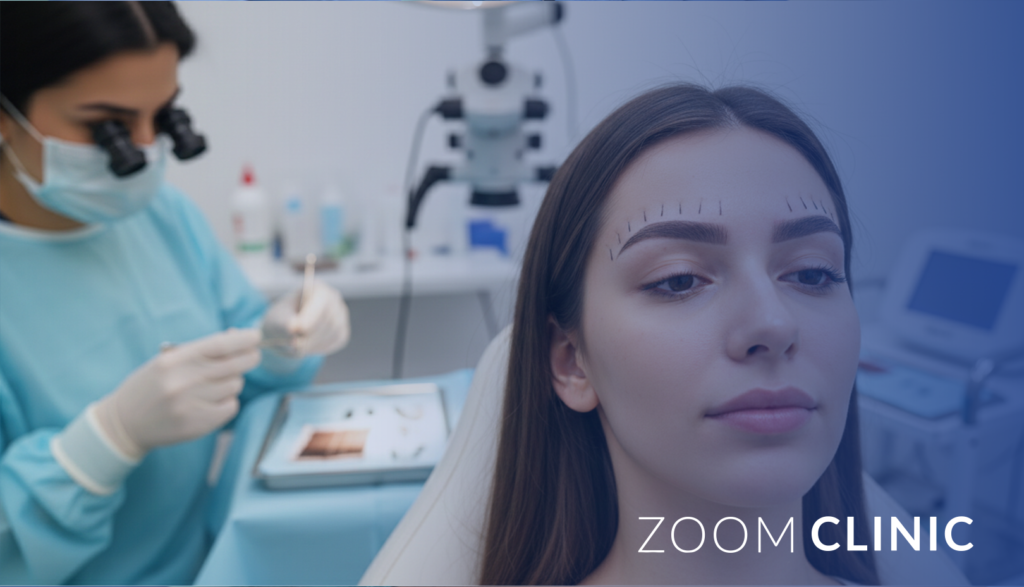
The strip technique (Follicular Unit Transplantation – FUT) is a surgical procedure aimed at transplanting hair follicles in the eyebrow area to restore natural density. This technique is based on extracting a thin strip from the scalp (usually from the back area) with a width ranging between 1-1.5 cm and a length proportional to the number of follicles required. After that, this strip is carefully dissected under a microscope to separate individual follicles, then planted one by one in the eyebrow area.
The strip technique is used in eyebrow transplantation for cases that require a large number of follicles, where 50-350 follicles per eyebrow can be obtained from a single strip. This technique is ideal for people who suffer from almost complete loss of eyebrows due to alopecia, burns, accidents, or excessive plucking over many years.
How is Eyebrow Transplantation Performed Using the Strip Technique (FUT)?
eyebrow transplant using the strip technique
1) Preparation and Anesthesia
- Consultation session to determine the eyebrow design and number of follicles according to facial features.
- Sterilization of the donor area and eyebrow area.
- Local anesthesia for both areas; the sensation of pain disappears after the anesthesia injection.
- This stage takes about 15–30 minutes.
2) Extracting the Strip from the Donor Area
- A thin strip is taken from the back of the scalp (1–1.5 cm wide, and length according to the required number).
- The area is chosen because it is resistant to hair loss and easy to hide with hair.
- The strip is extracted at an angle that preserves the integrity of the follicles, then preserved in a solution that maintains their vitality.
3) Dissecting the Strip and Separating Follicular Units
- The strip is broken down under a microscope into units that usually contain one or two hairs to suit the nature of eyebrows.
- Weak follicles are excluded, and healthy ones are preserved in a cold nutrient solution.
- The accuracy of this stage directly affects the success rate and final density.
4) Closing the Donor Area
- The wound is closed with precise sutures.
- Trichophytic Closure technique can be used to reduce the visibility of the scar and allow hair growth through it.
- The scar width is usually 1–2 mm and can be hidden if the hair length is appropriate.
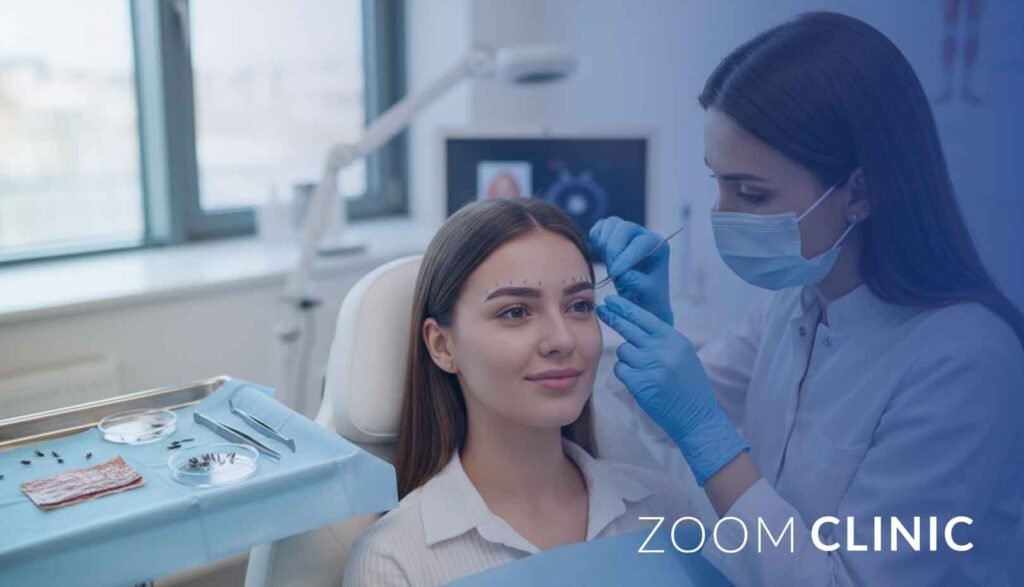
5) Opening Channels in the Eyebrows
- Precise channels are opened at low angles (about 15–30 degrees) to mimic the natural direction of hair.
- The front part is planted with single follicles, while double follicles may be used in the middle and end to achieve a natural gradient.
6) Planting the Follicles
- Follicles are planted one by one with calculated depth and direction.
- Distances are considered to achieve balanced density without crowding.
- The planting stage usually takes 2–3 hours, and the entire operation takes 4–6 hours depending on the required number.
Advantages of Eyebrow Transplant Using the Strip Technique (FUT)
1) Obtaining a Large Number of Follicles
- Allows extraction of 300–400 follicles or more in a single session without depleting the donor area.
- Suitable for completely rebuilding the eyebrow or significantly increasing density.
- Usually eliminates the need for multiple sessions, saving additional time and cost.
2) Higher Quality Follicles
- Follicular units are dissected under a microscope, excluding weak ones.
- Keeping the follicle surrounded by protective tissue during preparation reduces the damage rate.
- This is reflected in a better growth rate and more stable density after the operation.
3) Economic Cost
- Lower cost compared to FUE and DHI techniques due to the speed of extraction and simplicity of equipment.
- A suitable option for those looking for a strong result within a studied budget.
- The price may decrease by about 30–40% compared to newer techniques.
4) Speed of the Extraction Stage
- Strip extraction usually takes only 15–30 minutes.
- The time follicles spend outside the body is reduced, which preserves their vitality.
- The stress resulting from the long period of lying down during the operation is reduced.
Disadvantages and Drawbacks of the Strip Technique
1) Linear Scar
- Leaves a permanent scar approximately 1–2 mm wide in the best cases.
- May be visible when cutting hair very short.
- Advanced suturing techniques such as Trichophytic Closure reduce its visibility, but do not completely eliminate it.
2) Longer Recovery Period
- The presence of sutures means a feeling of tightness or pain in the back of the head for 1–2 weeks.
- Avoid sports and violent movements for 2–3 weeks.
- May require suture removal after 10–14 days if they are not dissolvable.
3) Need for High Surgical Expertise
- The accuracy of strip extraction and suturing directly affects the scar width and follicle success.
- Lack of expertise may lead to a wider scar or decreased growth rate.
- Choosing an experienced surgeon with documented results is a crucial factor in the success of the operation.
Comparison Between the Strip Technique and Other Eyebrow Transplantation Techniques
Choosing the appropriate technique depends on the number of follicles required, the desired eyebrow shape, the nature of the donor area, and the patient’s preferences regarding the scar and cost.
First: The Difference Between FUT and FUE in Eyebrow Transplantation
🔹 Method of Follicle Extraction
FUT (Strip): A thin strip is removed from the back of the head and then divided into follicular units under a microscope.
FUE (Extraction): Each follicle is extracted individually using a precise tool without removing a complete strip.
🔹 Scar in the Donor Area
FUT: Leaves a thin linear scar.
FUE: Leaves very small dots distributed on the scalp, usually unnoticeable.
🔹 Number of Follicles
FUT: Suitable for cases that need more than 200–250 follicles per eyebrow, or for complete reconstruction.
FUE: Suitable for filling light or medium gaps.
🔹 Cost and Flexibility
FUT is usually less expensive and faster in extracting a large number of grafts.
FUE gives the freedom to cut hair short without worrying about a linear scar.
Second: The Difference Between FUT and DHI in Eyebrow Transplantation
🔹 Planting Mechanism
In FUT and traditional FUE: Channels are opened first and then follicles are inserted.
In DHI (Choi pens): Planting is done directly using a special pen without opening channels beforehand.
🔹 Accuracy and Result
DHI provides very high control over the angle and direction of hair, but requires precise expertise.
FUT also gives natural results if angles are correctly adjusted.
🔹 Cost
DHI is usually higher in cost (may reach double or triple FUT).
FUT is a more economical option for large cases.
🔹 Number of Follicles in One Session
FUT excels when a large number of follicles is needed in one session.
DHI is more suitable for precise cases or limited cosmetic adjustments.
Brief Comparison Between the Three Techniques
| Element | FUT | FUE | DHI |
| Extraction Method | Complete strip | Individual extraction | Individual extraction |
| Scar Type | Linear | Small dots | Small dots |
| Number of Follicles | High in one session | Medium | Medium |
| Cost | Lower | Medium | Higher |
| Suitable for Complete Reconstruction | Yes | Sometimes | Less common |
When is the Strip Technique the Best Option?
FUT is considered the most suitable option in the following cases:
- Need for more than 250 follicles per eyebrow
- Complete eyebrow reconstruction
- Limited budget with desire for dense results
- Presence of thick hair longer than 2 cm to hide the scar
- Desire to complete the procedure in one session
When is it Preferable to Avoid It?
- When desiring to cut hair very short
- Having a history of keloid scars
- Previous strip operation in the same area
In these cases, FUE or DHI may be more suitable options.
Who are the Suitable Candidates for Eyebrow Transplant Using the Strip Technique (FUT)?
eyebrow transplant using the strip technique
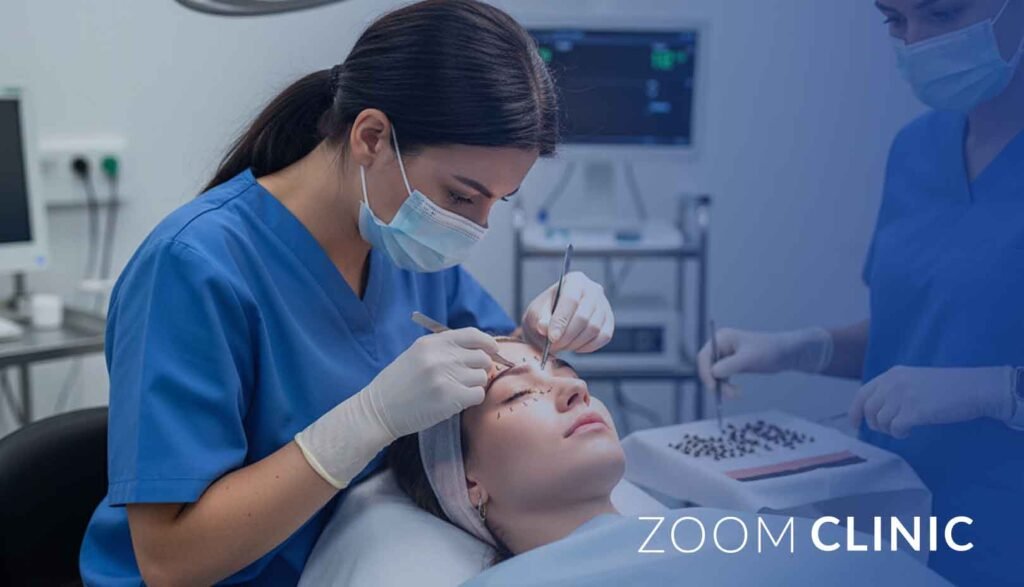
The FUT strip technique suits a specific category of patients, especially those who need a large number of follicles and focus on density and final result more than the issue of the back scar.
1) Cases That Need a Large Number of Follicles
Ideal candidates are those who:
- Need complete reconstruction of both eyebrows
- Want a large and noticeable density increase
- Have genetically very thin eyebrows
- Have done excessive plucking for years and hair stopped growing
In these cases, each eyebrow may need 200–350 follicles, a number that the strip technique can provide more efficiently compared to extraction techniques.
2) Cases of Complete Eyebrow Loss
Include:
- Those affected by Alopecia Totalis
- Those affected by Alopecia Areata
- Those who lost eyebrows due to chemotherapy or radiation
- Cases of burns or injuries that destroyed follicles
In these circumstances, the goal is not just filling gaps, but creating a complete eyebrow from scratch, which makes FUT a practical choice due to its ability to provide a large number of grafts in one session.
3) Those Who Don’t Mind the Linear Scar
The back scar is the main drawback of the strip technique. Therefore, it is suitable for those who:
- Keep medium or long hair covering the back of the head
- Do not intend to shave hair very short
- Give priority to density and cost over the cosmetic aspect of the donor area
It is important that the patient is aware of the nature of the scar and understanding of its expected appearance.
Steps Before Eyebrow Transplant Using the Strip Technique
Good preparation reduces complications and raises the success rate.
1) Required Medical Examinations
Usually the doctor requests:
- Complete blood count (CBC)
- Blood fluidity test
- Infectious disease tests (Hepatitis B and C, and HIV)
- Sometimes thyroid function test when hormonal disorder is suspected
The goal is to ensure there is no anemia, clotting disorders, or health problems that may affect wound healing and follicle growth.
2) Designing the Eyebrow Shape
The design stage determines the final result, and includes:
- Drawing the eyebrows to suit the face shape
- Considering symmetry of both sides
- Determining the angle and direction of hair growth
- Discussing patient expectations realistically
It is preferable to bring reference photos, but the final decision must consider facial harmony and not just personal desire.
3) Instructions Before the Operation
To ensure the best result:
- Stop blood-thinning medications two weeks before (after consulting the doctor)
- Stop smoking two weeks before and after the operation
- Avoid alcohol 3 days before the procedure
- Wash hair well on the morning of the operation
- Wear clothes with front buttons
- Eat a light meal before attending
Adhering to these instructions reduces bleeding, improves wound healing, and increases the success chances of transplanted follicles.
Recovery and Care After Eyebrow Transplant Using the Strip Technique (FUT)
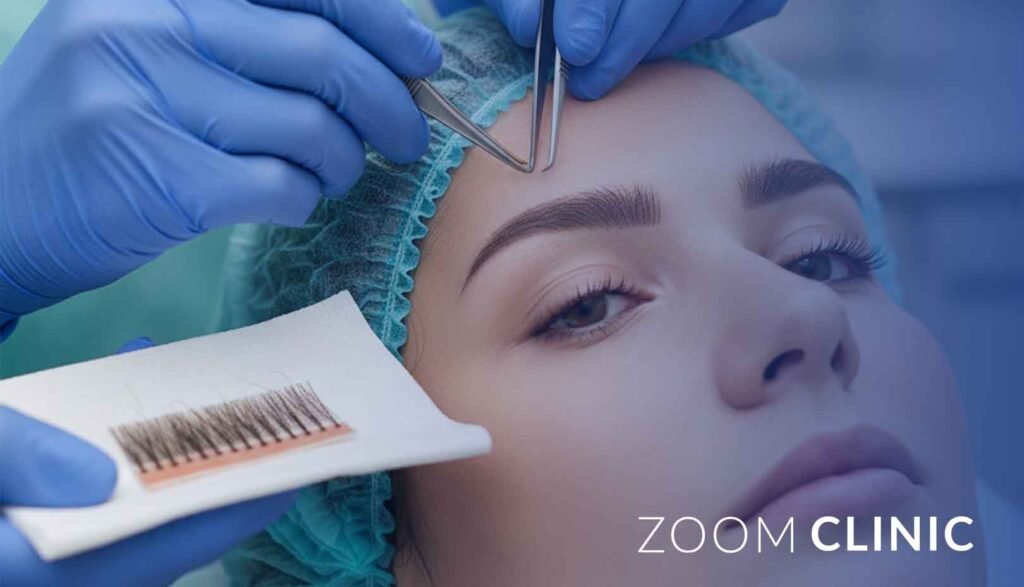
eyebrow transplant using the strip technique
1) Care for the Donor Area (Back of the Head)
- Avoid touching or scratching the area in the first days.
- Remove the bandage within 24–48 hours according to the doctor’s instructions.
- Sleep in a semi-sitting position or on the side to avoid pressure.
- Use only prescribed painkillers and antibiotics.
- Cold compresses can be placed around the area (not directly on it).
- Avoid washing hair for 3 days, then wash it gently without rubbing.
- Refrain from using hot hair dryers for two weeks.
2) Care for Transplanted Eyebrows
- Prevent touching or scratching for at least a week.
- Spray sterile saline solution every 2–3 hours during the first 3 days.
- Start gentle washing from the third day without rubbing.
- Apply topical antibiotic twice daily for a week.
- Avoid direct sun, swimming, sauna, and steam for a month.
Recovery Timeline
| Stage | What Happens |
| Days 1–3 | Light swelling and redness and mild pain that can be controlled |
| Days 4–10 | Formation of small crusts (left to fall off automatically) |
| Day 10–14 | Suture removal if not dissolvable |
| Week 3 – Month 2 | Shedding of transplanted hair (normal) |
| From Month 3 | Start of new hair growth |
| 6–12 months | Completion of final results |
Return to Activities
- Office work: After 3–5 days.
- Strenuous sports: After 3–4 weeks.
- Makeup away from eyebrows: After 3 days.
- Eyebrow makeup: After a month.
- Air travel: After a week.
- Hair dyeing: After a month.
- Eyebrow dyeing: After 3 months.
Suture Removal and Scar Reduction
Suture removal: After 10–14 days if not dissolvable.
Non-dissolvable sutures can be used that dissolve automatically within 2–3 weeks.
Trichophytic Closure Technique
An advanced suturing method that allows hair growth through the scar line to reduce its visibility by up to 40–60% compared to traditional suturing.
Reducing Scar Appearance
- Silicone creams for 3–6 months.
- Gentle massage after the first month.
- Sun protection for 6 months.
- In special cases: laser, steroid injections, or hair transplantation inside the scar.
Eyebrow Growth Stages
1) Temporary Shedding (Shock Loss)
Occurs between weeks 2–6, completely normal and does not mean operation failure.
2) Growth Beginning (3–4 months)
Hair appears gradually, initially thin and irregular.
3) Final Results (6–12 months)
90–95% of growth is completed, and density and shape stabilize.
Permanent Results
- Follicles are resistant to hormonal hair loss.
- Hair grows at the rate of the scalp, so it needs cutting every 2–3 weeks.
- In normal health conditions, results are permanent for life.
Success Rate
- Follicle growth rate: 85–95%.
- Depends on surgeon expertise, preservation quality during operation, and patient adherence to instructions.
Potential Complications (Rare)
- Infection (can be avoided by adhering to instructions).
- Slow wound healing especially in smokers or uncontrolled diabetics.
- Wider scar or keloid in cases of genetic predisposition.
Risk Reduction
- Choosing an experienced surgeon.
- Adhering to pre and post-operation instructions.
- Maintaining good general health and controlling chronic diseases.
Get the special offer today from Zoom Clinic
Conclusion:
Eyebrow transplant using the strip technique is an effective and scientifically proven surgical procedure to restore dense and natural eyebrows permanently. Although the technique leaves a linear scar in the donor area, it offers significant advantages in terms of the ability to obtain a large number of high-quality follicles at an economical cost. Results are permanent and very satisfactory when the procedure is performed by an expert surgeon.
The success of the operation depends greatly on choosing the appropriate doctor, adhering to preparation and care instructions, and patience during the growth period which may take 6-12 months to reach the final result. If you are thinking about eyebrow transplant using the strip technique, it is important to discuss all details with a specialized doctor to evaluate your condition and determine whether this technique is the most suitable for you.
For more information or to book a free consultation, you can contact us at Zoom Clinic, where we provide hair and eyebrow transplantation services with the latest techniques and by doctors with long experience and documented results.
read also Direct Hair Implantation DHI Precision and Excellence in Hair Restoration
Frequently Asked Questions About Eyebrow Transplant Using the Strip Technique
How many follicles are required to transplant one eyebrow?
The number of follicles required varies according to the condition and desired density. For a natural eyebrow, the number ranges between 50-175 follicles. In cases of complete loss or desire for very dense eyebrows, 200-350 follicles per eyebrow may be needed. The doctor determines the exact number based on case evaluation and required design.
Is the strip technique painful?
The operation itself is not painful thanks to effective local anesthesia. You may feel slight discomfort during the anesthesia injection, but after that you don’t feel any pain. After the operation, there may be mild to moderate pain in the donor area for 3-7 days that can be controlled with regular painkillers. Most patients describe the pain as similar to a moderate headache and completely bearable.
How long does eyebrow transplant using the strip technique take?
The operation usually takes between 4-6 hours from start to finish. This includes preparation and anesthesia, strip extraction and wound closure, strip dissection and follicle separation, channel opening, then follicle planting. Time varies according to the number of follicles required and the medical team’s speed, but the average is about 5 hours for a complete operation of both eyebrows.
Can the linear scar be completely hidden?
With advanced suturing techniques such as Trichophytic Closure and good care, the scar’s visibility can be reduced very significantly so that it becomes barely visible. The scar is usually only 1-2 mm wide and easy to completely hide with hair 2 cm long or more. However, the scar remains permanently present, and if you shave your hair completely or cut it very short, the scar will be visible.
When can transplanted eyebrows be dyed?
It is recommended to wait at least 3 months after the operation before dyeing transplanted eyebrows. Follicles need this period to settle and grow strongly. Using dye before that may damage weak follicles or cause skin irritation. After 3 months, you can use natural and gentle dyes specific to eyebrows, but it is preferable to consult the doctor before that and perform a sensitivity test first.