
A beautiful smile is no longer a distant dream; it has become an achievable reality thanks to remarkable advancements in cosmetic dentistry. Clear orthodontic treatment with Invisalign represents a true revolution in the field of orthodontics, combining clinical effectiveness with an almost invisible aesthetic appearance. In recent years, Turkey has emerged as a leading destination for obtaining Invisalign treatment at affordable costs with internationally recognized quality.
Thousands of Arab and international patients are searching for a modern alternative to traditional metal braces. Here, Invisalign in Turkey stands out as an ideal option that brings together medical professionalism, competitive pricing, and comprehensive services. In this comprehensive guide, we will explore everything you need to know about costs, treatment duration, and expected results.
content
What Is Clear Orthodontic Treatment (Invisalign)?
Definition and Scientific Principle
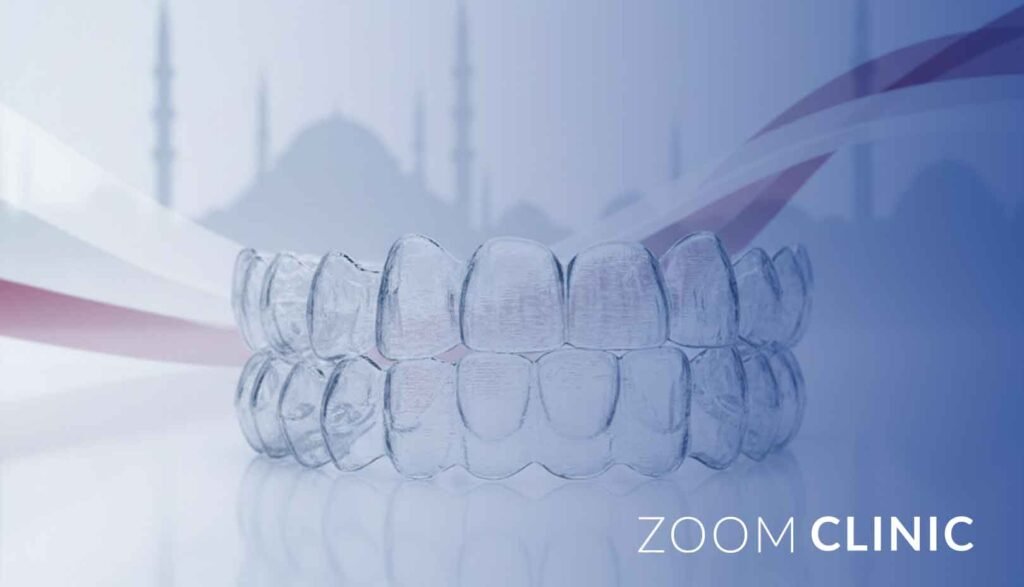
Invisalign is a modern orthodontic system that relies on removable, transparent aligners made from an advanced medical-grade plastic material known as SmartTrack. These clear aligners are custom-designed for each patient using three-dimensional digital scanning technology and artificial intelligence. The principle of treatment is based on gradually moving the teeth into their desired positions through a sequence of aligners, with each aligner replaced by a new one every one to two weeks.
The SmartTrack material is characterized by high flexibility and its ability to distribute pressure evenly across the teeth, making the orthodontic process more comfortable and effective. Each aligner is designed to move teeth by only 0.25 to 0.33 millimeters, and this slow, controlled movement is the key to the success of the technique and patient comfort.
Difference Between Invisalign and Traditional Braces
Traditional orthodontic treatment relies on fixed metal brackets and wires that remain attached to the teeth throughout the treatment period, whereas Invisalign offers a clear, removable solution. In terms of aesthetics, clear aligners are virtually unnoticeable compared to shiny metal braces. In terms of comfort, Invisalign does not cause gum or tongue injuries and ulcers that are often associated with metal brackets.
Clear orthodontic treatment is an ideal option for adults and adolescents who wish to improve their smile without affecting their appearance or self-confidence. The ability to remove the aligners while eating also makes the treatment experience more flexible and convenient in daily life.
Conditions Treated with Clear Orthodontics
Dental Issues Suitable for Treatment
Invisalign effectively treats a wide range of dental issues. Among the most common are mild to moderate dental crowding, where teeth are misaligned due to limited jaw space. It also treats gaps and excessive spacing between teeth, which may result from missing teeth or naturally small tooth size.
Other conditions treated with clear aligners include deep bite (when upper teeth excessively overlap lower teeth), open bite (when front teeth do not meet upon biting), and crossbite (when some upper teeth bite inside the lower teeth). Invisalign is also used to correct protruding front teeth and improve overall jaw alignment.
Cases Not Suitable for Clear Orthodontics
Despite its effectiveness, some complex cases require traditional orthodontic treatment. Conditions that involve significant root movement or severe tooth rotation may not be ideal for clear aligners. Likewise, severe skeletal jaw discrepancies that require surgical intervention may necessitate a different treatment approach.
It is essential for the dentist to carefully and honestly evaluate your case to determine whether Invisalign is the most appropriate option. Transparency at this stage ensures optimal results and prevents wasted time and expense on unsuitable treatment.
Cost of Clear Orthodontic Treatment in Turkey (2026)
Price Range and Estimated Cost
The cost of Invisalign treatment in Turkey typically ranges between USD 1,500 and USD 3,500, which is highly competitive compared to other countries. This price range depends on several factors discussed below, but what matters most is that Turkey offers global-quality treatment at significantly lower costs than Europe, the United States, and many Arab countries.
The final cost is determined after an initial examination and comprehensive evaluation of your case, during which the dentist estimates the number of aligners required and the expected duration of treatment. It is important to receive a detailed, all-inclusive quotation to avoid any unexpected expenses later.
Factors Affecting the Cost
The complexity of the case is the primary factor influencing cost. Simple cases requiring 12–20 aligners are less expensive than complex cases that may require 40–50 aligners or more. The dentist’s experience and the clinic’s reputation also play a role; Invisalign-certified providers with advanced training may charge slightly higher fees in exchange for greater expertise.
Technologies used in the clinic, such as iTero 3D digital scanners and advanced virtual simulation software, add value to the service and may affect pricing. Additional services—such as multiple consultations, remote follow-up for international patients, and post-treatment retainers—also contribute to the total cost.
Price Comparison: Turkey vs. Other Countries
To put things into perspective, here is a quick comparison of average costs:
- Turkey: USD 1,500 – 3,500
- Saudi Arabia: USD 3,000 – 7,000
- United Arab Emirates: USD 3,500 – 8,000
- Egypt: USD 1,800 – 4,000
- Europe: EUR 4,000 – 8,000
- United States: USD 5,000 – 9,000
This comparison clearly shows that Turkey offers savings of approximately 40% to 60% compared to European and Gulf countries. This significant difference is due to lower operating and labor costs in Turkey, without compromising material quality or medical standards.
What the Price Usually Includes
When inquiring about the cost of clear orthodontic treatment in Turkey, make sure the quoted price includes: a comprehensive initial consultation and clinical examination, all necessary radiographs and diagnostic images, digital 3D scanning of the jaws, digital treatment planning and virtual outcome simulation, all aligners required throughout the treatment period, regular follow-up visits, and final retainers after treatment completion.
Many clinics specializing in medical tourism offer all-inclusive packages that may also include airport transfers, hotel accommodation, transportation, and translation services, making the overall experience more convenient for international patients.
Duration of Invisalign Treatment
Expected Treatment Timeline
The duration of Invisalign treatment in Turkey typically ranges from 6 to 18 months in most cases and may often be shorter than traditional braces. Simple cases requiring minor adjustments may take only 6–9 months, moderate cases usually last 10–14 months, while more complex cases may extend to 18 months or slightly longer.
Factors influencing treatment duration include the severity of misalignment or crowding, individual biological response to tooth movement, patient compliance with daily wear time, and age (as younger patients’ teeth generally respond faster). Strict adherence to the dentist’s instructions is crucial for achieving optimal results in the shortest possible time.
Treatment Timeline Stages
During the first few weeks of treatment, you may begin to notice subtle changes in tooth position and experience mild pressure with each new aligner—an indication that the treatment is progressing as planned. After 3 to 6 months, results become more noticeable, particularly in the anterior teeth, with a clear improvement in smile alignment.
Between 12 and 18 months, final results are achieved as teeth reach their planned ideal positions. At this stage, the dentist prepares retainers to maintain the results and prevent relapse.
Daily Wear Time Requirements
The success of Invisalign treatment depends heavily on wearing the aligners for 20 to 22 hours per day. This means removing them only while eating, drinking anything other than water, and brushing your teeth. Failure to comply with this requirement can prolong treatment duration or compromise results.
Many patients mistakenly believe that removing aligners for a few extra hours will not make a significant difference, but continuous pressure is essential for proper tooth movement. Discipline and consistency are therefore key to success.
Aligner Change Frequency and Follow-Up
Aligners are typically changed every one to two weeks, depending on the treatment plan. Some cases require faster changes, while others need longer intervals. Your dentist will provide several aligners in advance along with a clear schedule for switching them.
Follow-up visits are usually scheduled every 6 to 8 weeks. During these appointments, the dentist evaluates progress, ensures that tooth movement is proceeding according to plan, and provides the next set of aligners. These visits are significantly less frequent than those required for traditional braces, which often require monthly adjustments.
Stages of Obtaining Clear Orthodontic Treatment in Turkey
Step 1: Initial Consultation and Examination
Your Invisalign journey begins with a comprehensive consultation, during which the dentist thoroughly examines your teeth and gums to ensure overall oral health. This visit includes a detailed clinical examination, panoramic radiographs of the jaws, and photographic documentation of the teeth from multiple angles. The dentist discusses your expectations and treatment goals and explains available options.
Based on this assessment, the dentist determines whether Invisalign is suitable for your case or if an alternative approach is required. Any existing gum disease or dental caries must be treated before starting orthodontic therapy to ensure successful outcomes.
Step 2: Digital 3D Scanning
If your case is suitable, the next step involves digital scanning of the jaws using an iTero scanner or similar advanced devices. This technology captures thousands of images within minutes to create a highly accurate three-dimensional digital model of your teeth and jaws.
This process is comfortable and eliminates the need for traditional impression materials that may cause discomfort or gag reflex. It is also far more precise, ensuring that the aligners fit perfectly. Following the scan, the dentist can show you a virtual simulation of your expected results, helping you make an informed decision.
Step 3: Custom Aligner Design
After digital scanning, all data are sent to Invisalign’s specialized laboratories, where a team of experts—supported by advanced artificial intelligence software—designs a precise treatment plan. Each tooth movement is planned individually, determining the number of aligners required and the expected treatment duration.
Design and manufacturing typically take two to three weeks. During this time, the laboratory may communicate with your dentist to refine certain details. Once the treatment plan is approved, all aligners are manufactured at once.
Step 4: Fitting and Treatment Initiation
When the aligners arrive at the clinic, you are scheduled for a fitting appointment. The dentist ensures that the first aligner fits perfectly and may place small, clear attachments on certain teeth to enhance aligner grip and movement efficiency.
You will receive detailed instructions on how to insert, remove, and clean the aligners, as well as guidance on daily wear time. You will also be given several aligners in advance with a clear schedule for progression. Strict adherence to these instructions is essential for optimal results.
Step 5: Periodic Follow-Up
Throughout treatment, follow-up visits are required every 6–8 weeks. During these visits, the dentist monitors progress and makes minor adjustments if necessary, while providing the next set of aligners.
For international patients who cannot visit Turkey frequently, many clinics offer remote follow-up options. You can send regular photos of your teeth via specialized applications, allowing the dentist to monitor progress remotely. This makes Invisalign an excellent choice for patients traveling from abroad.

Expected Results of Clear Orthodontic Treatment
Short-Term Results (First Weeks)
In the initial weeks, dramatic changes may not be immediately visible, but mild pressure on the teeth is normal and indicates that the aligners are working. Some anterior teeth may begin to move slightly, and you will gradually adapt to the new sensation and routine.
This phase is important for developing discipline and compliance. Minor challenges such as temporary speech difficulty or increased salivation may occur but usually resolve within a few days.
Medium-Term Results (3–6 Months)
After 3 to 6 months, results become clearly noticeable. Anterior teeth align more effectively, gaps begin to close, and crowding is significantly reduced. This stage is highly motivating, as you begin to see tangible improvements from your commitment.
Many patients report increased self-confidence during this phase, feeling more comfortable smiling and speaking. The gradual nature of the change means others often notice improvement without realizing that orthodontic treatment is being used—one of Invisalign’s greatest advantages.
Long-Term Results (12–18 Months)
By the end of treatment, typically between 12 and 18 months, final results are fully achieved. Teeth reach their planned ideal positions, and your smile becomes harmonious and balanced. Beyond aesthetics, functional improvements in bite and chewing efficiency are common, and issues such as jaw discomfort caused by malocclusion may resolve.
These results can last a lifetime, provided that you follow one essential rule: wearing retainers as instructed. Without retainers, teeth may gradually shift back to their original positions—a phenomenon common to all orthodontic treatments, not just Invisalign.
Factors Contributing to Treatment Success
The success of clear orthodontic treatment depends on three main factors: strict adherence to wearing aligners for 20–22 hours daily, regular follow-up with the dentist, and proper oral hygiene and aligner care.
Patients who comply with these factors consistently achieve excellent results within the expected timeframe. Those who neglect compliance may experience prolonged treatment or suboptimal outcomes.
Frequently Asked Questions (FAQ)
Is Invisalign Painful?
Invisalign is generally less painful than traditional braces. You may experience mild pressure or discomfort during the first few days of wearing a new aligner, which is normal and indicates effective tooth movement. This sensation typically subsides within 2–3 days.
How Many Hours Per Day Should Invisalign Be Worn?
Dentists recommend wearing Invisalign aligners for 20–22 hours per day for optimal results. They should be removed only during meals, consumption of hot beverages, or oral hygiene. Compliance is essential to ensure teeth move according to plan and to avoid treatment delays.
Can You Eat and Drink with Invisalign?
Aligners should be removed before eating or drinking anything other than cool or room-temperature water. Eating with aligners can damage or stain them, and hot beverages may distort their shape. After meals, teeth should be cleaned thoroughly before reinserting the aligners to maintain oral hygiene and prevent decay.
When Do Invisalign Results Become Visible?
Initial improvements may be noticed within the first few weeks as minor alignment changes occur. After 3–6 months, results become more evident, particularly in the front teeth. Final results are typically achieved after 12–18 months, depending on case complexity and compliance.
Are Invisalign Results Permanent?
Invisalign results can be permanent if retainers are worn according to the dentist’s instructions after treatment completion. Without retainers, teeth may gradually relapse. Usually, full-time retainer wear is recommended initially, followed by nighttime wear to maintain results long term.
Conclusion and Next Steps
Clear orthodontic treatment with Invisalign in Turkey offers an excellent opportunity to achieve a perfect smile at an affordable cost with world-class quality. With prices ranging from USD 1,500 to 3,500, treatment durations of 6 to 18 months, and predictable results when instructions are followed, the choice becomes clear for those seeking a modern and effective solution.
The key to a successful Invisalign journey lies in choosing a reputable, experienced clinic and maintaining strict compliance with aligner wear and follow-up visits. Remember, investing in your smile is an investment in your confidence and long-term oral health.
If you are seriously considering clear orthodontic treatment, the first step is to book a free consultation with medical tourism specialists who can evaluate your case and provide a personalized treatment plan. At zoom-clinic.com, we offer comprehensive support from initial consultation to post-treatment follow-up, along with integrated services that ensure a smooth and comfortable experience.
Get the special offer today from Zoom Clinic
read also Pain-Free Cosmetic Dentistry: Anesthesia and Comfort Options